



This is the post behind the post. If you read "Why Does It Feel Like Failing Even When You're Doing Everything?" and thought — yes, but why is my brain like that — this one's for you.
This post discusses childhood trauma, emotional abuse, and estrangement from family. Please take care of yourself as you read.
I was nine years old the first time I understood that love had conditions.
Not in a way I could name then. Not in a way anyone sat me down and explained. But in the way children understand things — through pattern, through repetition, through the slow accumulation of what happens when you fall short versus what happens when you don't.
What I learned was this: being useful was safer than just being. Being agreeable was safer than being honest. Being productive, compliant, good — these were the things that kept the temperature in the room from changing.
So I became very good at all of them.
And I have spent the last several years in therapy — including a year and a half of EMDR — slowly, painfully unlearning what that taught me.
What EMDR Actually Does
If you're not familiar with EMDR — Eye Movement Desensitization and Reprocessing — it's a trauma therapy that helps the brain reprocess memories that got stuck. Traumatic memories don't always store the way normal memories do. They can stay frozen, vivid, emotionally present — like the nervous system never got the memo that the event is over.
EMDR helps the brain file them properly. Integrate them. Let them become past tense instead of present tense.
What that looked like for me in practice was sitting with a therapist and revisiting memories I had spent decades not revisiting — and finding, underneath them, the beliefs they had quietly installed.
Beliefs like:
I am only valuable when I am useful. Disappointing people is dangerous. If I slow down, something bad will happen. I have to earn my place in every room I'm in.
These didn't come from nowhere. They came from a childhood where those things were functionally true. Where love felt contingent. Where safety felt earned. Where the cost of falling short was real enough that my nervous system built an entire operating system around never doing it.
The problem is that nervous system came with me into adulthood. Into my marriage. Into my career. Into the business I built. Into every room I walk into.
And it still runs the same calculations it learned when I was nine.
Performance as Survival
Here's what that looks like in practice, for me, on an ordinary Tuesday:
I wake up and my brain is already running a threat assessment. Not consciously. Not dramatically. Just quietly in the background — scanning for what's undone, what's overdue, what someone might need from me that I haven't delivered yet.
I walk my dog. I answer emails. I run my business. I show up to meetings. I handle client work. I prep for a job interview.
And somewhere around 1pm, my husband mentions — gently, reasonably — that the suitcase from our honeymoon is still packed. That he'd love a home-cooked meal a few nights a week. That the groceries need ordering.
All reasonable things. Normal married-people things.
And my nervous system translates them as: you are failing. You are not enough. Someone is disappointed.
Not because Eric said any of that. He didn't. But because the little girl who learned that disappointing people was dangerous is still in there, still running that old software, still filing "someone mentioned something undone" under "threat."
That's not a character flaw. That's a survival mechanism that outlived its usefulness.
What I Had to Learn to Name
One of the hardest parts of trauma recovery — at least for me — has been learning to distinguish between a present-tense problem and a past-tense wound being activated.
Because they feel identical from the inside.
When I feel like I'm failing as a wife because the laundry isn't done, that feeling is completely real. The shame is real. The urgency is real. The fear of being not enough is real.
But the source of it isn't the laundry. The source of it is decades-old. It's a nine-year-old who learned that falling short had consequences. It's every time love felt like it had to be earned. It's every environment where being useful was the price of belonging.
The laundry is just the trigger. The wound is much older.
And once I learned to see that — to say oh, this is the old thing, not the current thing — it didn't make the feeling go away. But it made it slightly less authoritative. Slightly less like fact.
Going No Contact
In November 2023 I stopped talking to my parents.
That's a sentence that still feels strange to write. It probably always will.
I didn't make that decision lightly. I made it after years of therapy, after EMDR, after finally being able to see clearly — without the distortion of a child who needed to believe her parents were safe — what had actually happened and what it had cost me.
And what it had cost me, among other things, was the ability to believe I was enough without proof.
Because when you grow up being told — implicitly, explicitly, in a hundred different ways — that your worth is contingent on your performance, you don't just believe it about your parents. You believe it about everyone. You carry it into every relationship, every job, every room. You spend your whole life trying to earn something that was always supposed to be unconditional.
Going no contact was, in its own way, an act of self-compassion. The hardest one I've ever performed.
It was me finally saying: I am not going to keep trying to earn love from people who made the conditions impossible. I am going to go find out what it feels like to just be — without the performance, without the compliance, without the constant recalculation of whether I'm enough.
I'm still finding out.
What I'm Learning Instead
I am not going to tell you I've figured this out. I haven't.
I still end days where I've done everything and feel like I've done nothing. I still hear Eric say something reasonable and feel the old alarm system fire. I still catch myself measuring my worth in output — in orders shipped, in emails answered, in to-do lists completed — before I catch myself doing it.
But I'm learning, slowly, to ask a different question.
Instead of: did I do enough today?
I'm trying to ask: was I a person today?
Did I show up for the people I love? Did I try? Did I move through the world with some intention toward good? Did I take care of something that needed taking care of — even if it was just myself?
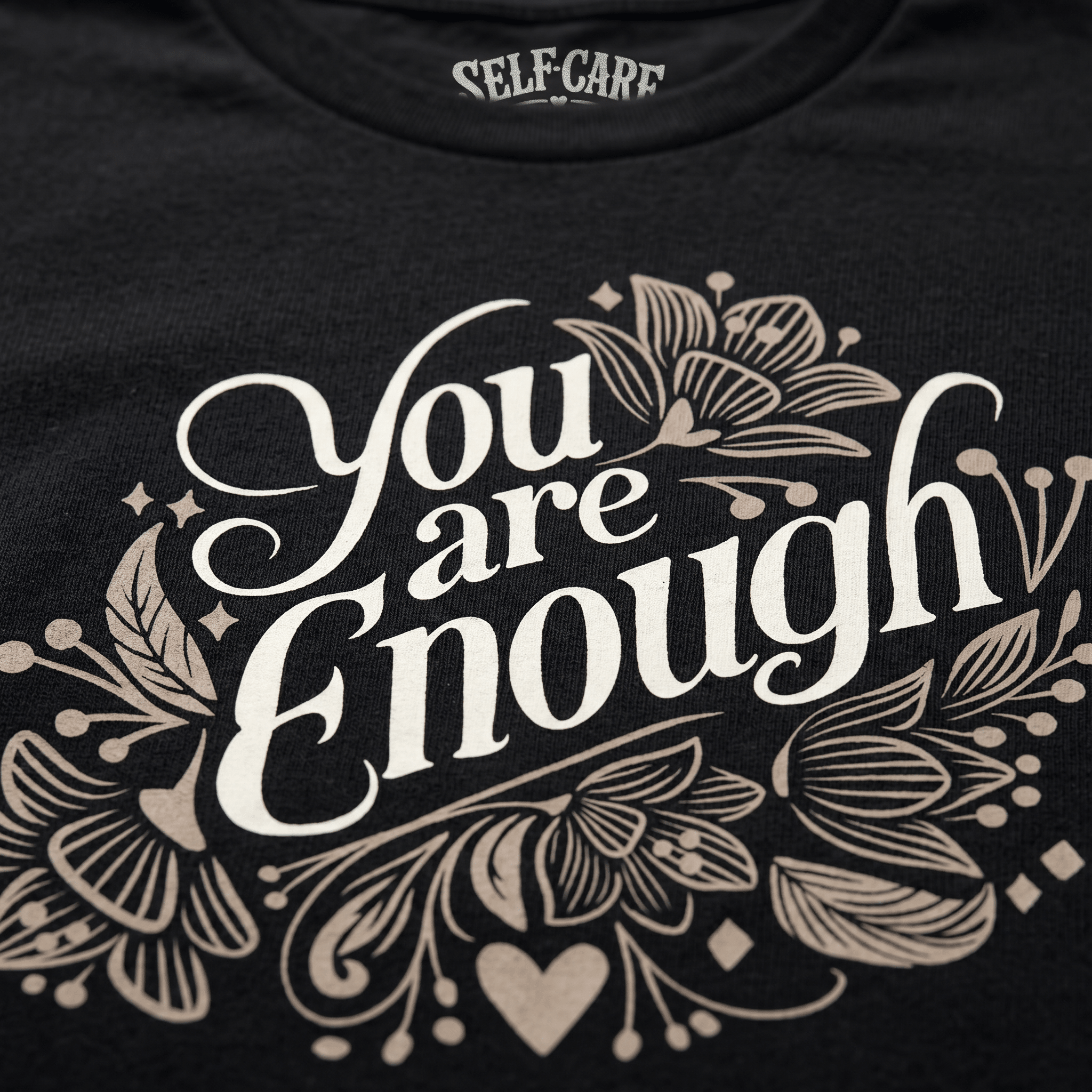
Because you are enough is not a productivity metric. It was never supposed to be. It's a statement about your inherent worth as a human being — one that exists regardless of the laundry, the groceries, the suitcase, the to-do list, the job you did or didn't get.
It doesn't have to be earned.
It never did.
If You Recognize This Pattern
If any of this sounds familiar — if you also run that constant background calculation, if you also translate "something is undone" into "I am not enough" — I want to gently suggest that it probably didn't start with you.
Somewhere, someone taught you that love was conditional. That safety was earned. That your worth was a performance review, not a given.
And your nervous system learned that lesson very well.
The work of unlearning it is slow and nonlinear and deeply unglamorous. It looks like therapy. It looks like EMDR. It looks like sitting with memories you'd rather not sit with and finding the beliefs underneath them. It looks like going no contact, or having hard conversations, or just noticing — on an ordinary Tuesday — that the alarm that just fired is from 1999 and doesn't actually apply to the current situation.
It looks like wearing a shirt that says Not Broken on the days you're not sure you believe it yet.
And it looks like being willing to ask, even when the answer is hard to find:
What if I was always enough? What if I just learned, very early, to believe otherwise?
Because I think for a lot of us — that's exactly what happened.
And I think it's worth spending the rest of our lives finding our way back from it.
Alyssa is the founder of Self-Care Shirts — a mental health awareness apparel brand where every design started as something she personally needed to hear. 10% of proceeds are donated to 988 and The Trevor Project.
If this post found you at the right time, our Gifts for Someone in Recovery collection has designs that honor exactly this kind of healing. The You Are Enough Hoodie is the coziest way to carry that reminder on the hard days. And our Gifts for Therapy-Goers collection has everything for the people doing the work.


